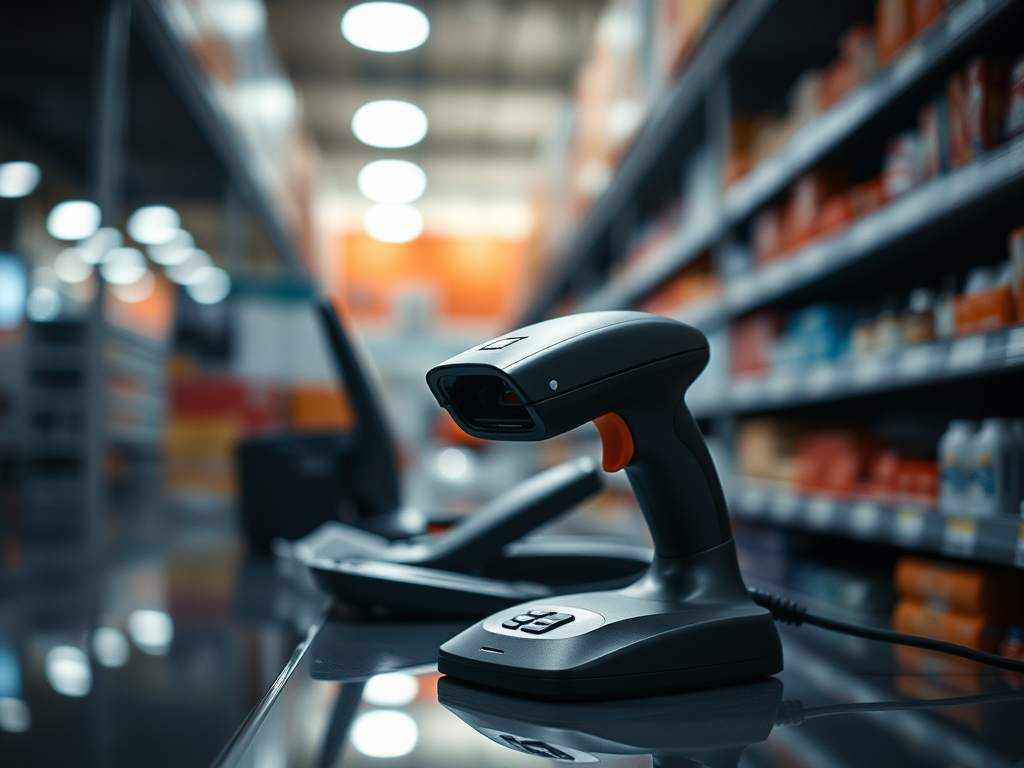

Barcode scanners are essential tools in retail and inventory management, providing a fast and accurate way to track products, streamline transactions, and manage stock. By interpreting barcode data, these devices facilitate seamless Point of Sale (POS) operations and inventory control. This article explores the various types of barcode scanners, the different types of barcodes used in POS systems, and the configurations that impact their functionality.
Types of Barcode Scanners
1. Laser Scanners
Laser scanners use a laser beam to scan and decode barcodes. They are known for their high speed and accuracy, making them suitable for high-volume scanning environments.
- Linear Laser Scanners: These scanners read one-dimensional (1D) barcodes, such as UPC and EAN codes. They work by emitting a laser beam that sweeps across the barcode, with sensors detecting the reflected light to decode the data.
- Advantages: High scanning speed, accurate in various lighting conditions, reliable for long-range scanning.
- Disadvantages: Limited to 1D barcodes, less effective with damaged or poorly printed barcodes.
2. CCD Scanners
Charge-Coupled Device (CCD) scanners use an array of light sensors to capture barcode images. They are often found in handheld scanners and are used for short-range scanning.
- Advantages: Compact design, reliable for close-range scanning, less sensitive to ambient light.
- Disadvantages: Typically slower than laser scanners, may struggle with high-density barcodes or longer distances.
3. Imager Scanners
Imager scanners, also known as 2D imagers or camera-based scanners, use cameras to capture and decode both 1D and 2D barcodes. They are versatile and can scan barcodes from various angles and distances.
- Advantages: Capable of reading both 1D and 2D barcodes, can capture barcodes from screens and damaged labels, versatile and adaptable.
- Disadvantages: Generally more expensive than laser or CCD scanners, may require more processing power.
4. Fixed-Mount Scanners
Fixed-mount scanners are permanently installed in a specific location, such as at a checkout counter or conveyor belt. They are used for automated scanning in high-throughput environments.
- Advantages: Hands-free operation, high-speed scanning, ideal for high-volume settings.
- Disadvantages: Limited to specific installation points, may require more complex setup and integration.
5. Wireless Scanners
Wireless scanners operate using Bluetooth or other wireless technologies, allowing greater mobility and flexibility in scanning operations.
- Advantages: Enhanced mobility, reduces cable clutter, ideal for dynamic or mobile environments.
- Disadvantages: Potential for battery life issues, may require additional setup and configuration.
Types of Barcodes
1. 1D Barcodes
One-dimensional barcodes consist of parallel lines of varying widths and spacings. They are widely used in retail for item identification and tracking.
- UPC (Universal Product Code): Commonly used in North America, UPC codes have 12 digits and are standard for retail products.
- EAN (European Article Number): Similar to UPC, EAN codes are used internationally and typically have 13 digits.
- Code 39: Used in various industries, including manufacturing and logistics, Code 39 can encode letters and numbers.
2. 2D Barcodes
Two-dimensional barcodes encode data in both horizontal and vertical dimensions, allowing for more information to be stored in a smaller space.
- QR Code (Quick Response Code): A popular 2D barcode used for a variety of applications, including marketing and product information. QR codes can store up to 7,089 numeric characters.
- Data Matrix: Used in industries such as healthcare and manufacturing, Data Matrix codes can store large amounts of data in a compact form.
- PDF417: Often used for documents and identification cards, PDF417 codes can encode large data sets, including text and images.
Barcode Configurations for POS Systems
1. Barcode Formats
Different POS systems may require specific barcode formats to ensure compatibility. Common formats include:
- Standard Formats: UPC and EAN codes are standard in retail environments, ensuring that products are easily identifiable and scannable across different systems.
- Custom Formats: Some businesses may use custom barcode formats to meet specific needs or to integrate with existing inventory systems.
2. Data Encoding
The way data is encoded in a barcode affects how it is read and processed:
- Numeric Encoding: Barcodes that store numeric data only, such as UPC codes, are straightforward and typically used in retail.
- Alphanumeric Encoding: Barcodes that store both letters and numbers, like Code 39, offer greater flexibility and are used in various industries.
- Binary Encoding: 2D barcodes like QR codes and Data Matrix use binary encoding, allowing for the storage of complex data sets, including URLs, text, and more.
3. Scanning Distance and Angle
Barcode scanners must be able to read barcodes effectively from various distances and angles:
- Short-Range Scanning: CCD scanners and some laser scanners are optimized for close-range scanning, suitable for retail checkout counters.
- Long-Range Scanning: Imager scanners and advanced laser scanners can read barcodes from greater distances, ideal for warehouse environments and large retail spaces.
4. Symbology
Different barcode symbologies (the method used to encode data) may be required depending on the POS system:
- Symbology Compatibility: Ensure that the barcode scanner and POS system support the same symbologies to avoid compatibility issues.
- Configuration: Barcode scanners often come with configurable settings to support various symbologies and adapt to different scanning environments.
Conclusion
Barcode scanners and barcodes are integral to modern retail and inventory management, enabling efficient tracking and sales processes. Understanding the types of barcode scanners—laser, CCD, imager, fixed-mount, and wireless—along with the various barcode formats and configurations, helps businesses choose the right technology for their needs. By selecting appropriate scanners and barcode types, retailers can enhance their operational efficiency, improve customer service, and maintain accurate inventory control.